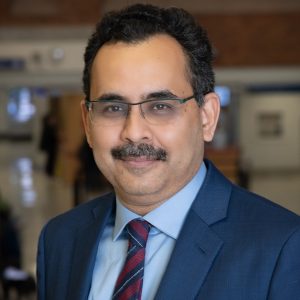




For this issue of the SNACC Newsletter, it is my honour to interview Dr. Lakshmikumar Venkat Raghavan. Dr. Venkat Raghavan is a Professor at the Department of Anesthesiology & Pain Medicine in the University of Toronto’s Temerty Faculty of Medicine. He completed his medical school and anesthesia training in India. He then completed further anesthesia training in the United Kingdom, followed by a neuroanesthesia fellowship at Toronto Western Hospital. He has been working as a staff anesthesiologist at Toronto Western Hospital since 2005. He is the Director of Neuroanesthesia Program at Toronto Western Hospital and the medical director of the Neurosurgical Intraoperative Monitoring department at University Health Network. He was the program Director for the Neuroanesthesia Fellowship at Toronto Western Hospital from 2011 to 2023. During that time, he has mentored more than 60 fellows. Currently, he is the Director of Fellowship Program at the Department of Anesthesiology & Pain Medicine at the University of Toronto, one of the largest fellowship programs with 150 fellows per year.
He is an active researcher and a clinician-investigator at the Krembil Brain Institute, with more than 120 peer-reviewed publications focusing on neuroscience and neuroanesthesia. His areas of expertise include functional neurosurgery, same-day discharge after neurosurgery, and functional neuroimaging, including the development of a brain stress test.
- Why did you choose a career in Neuroanesthesiology? Was there a specific experience that inspired you to pursue this career?
Early in my anesthesia residency, I was on call for a neurosurgical case involving a nine-year-old child undergoing a posterior fossa craniotomy in the sitting position. Throughout the procedure, the neurosurgeon repeatedly asked about blood pressure, heart rate, end-tidal CO₂, hemoglobin, and temperature.
It was the first time I truly appreciated how closely every physiologic variable influenced the brain and the surgical field. I was struck by how small changes in hemodynamics, ventilation, or anesthetic depth could meaningfully affect cerebral perfusion and outcomes.
Subsequent exposure to awake craniotomies, functional neurosurgery and complex cerebrovascular cases deepened that interest. I realized neuroanesthesia is not simply about supporting surgery—it is about continuous physiologic optimization and, at times, participating in functional mapping and diagnostic processes. The combination of precision, physiology-driven practice, and the opportunity to directly influence neurological recovery ultimately convinced me that Neuroanesthesiology was the right field for me.
- Who have been the most influential mentors in your career?
I have been fortunate to have exceptional mentors at every stage of my career. During my residency at King Edward VII Hospital in Mumbai, Dr. D. B. Deval first sparked my interest in neuroanesthesia. Later, during my training in the UK, Dr. Judith Dinsmore helped shape my career direction.
The most formative influence was Dr. Pirjo Manninen during my fellowship in Toronto. Her clinical rigor, calmness in complex situations, and dedication to teaching profoundly shaped how I practice and teach today. Further, much of my professional growth and academic achievements reflects her mentorship
I have also learned greatly from interdisciplinary collaborations in neurosurgery, neuroradiology, neurology and physiology. And importantly, my trainees have been powerful teachers—continually pushing me to remain current and to explain not only how we practice, but why.
- You have won numerous Clinical Excellence and Teaching Awards. How would you describe your teaching philosophy? Has your approach to teaching changed over time?
My philosophy centers on facilitating learning rather than simply transmitting information. Knowledge is retained when learners understand its clinical relevance and can apply it.
Early in my career, I focused on content delivery and technical proficiency. Over time, I shifted toward developing clinical reasoning and structured thinking under uncertainty. I now spend more time guiding trainees through complex decision-making rather than outlining protocols.
Teaching is a two-way process. Learners bring fresh perspectives, and their feedback continually refines my approach. My goal is for trainees to leave not only knowing what to do, but understanding why—and feeling confident in their decisions.
- What neuroanesthesia principle or teaching point are you most passionate about?
Two principles guide my practice.
First: protecting the brain requires a deep understanding of cerebrovascular physiology.
Second: in neurosurgery, the difference between a good and poor outcome can be just a few mmHg—whether arterial pressure, venous pressure, airway pressure, or PaCO₂.
Technology helps, but it cannot replace understanding cerebral blood flow, autoregulation, and CO₂ reactivity. I often tell trainees that neuroanesthesia is applied physiology in real time.
- What led you to explore and develop your research expertise in brain stress testing and cerebrovascular reactivity?
It began with a clinical gap. We see many patients with intracranial steno-occlusive disease, particularly Moyamoya vasculopathy, undergoing revascularization. Conventional imaging shows anatomy—but not how well the brain is coping. Functional assessment of cerebrovascular reserve has long been a challenge.
The intellectual foundation for the “brain stress test” came from the pioneering work of Dr. Joe Fisher and Dr. David Mikulis, who developed the use of precisely controlled CO₂ combined with BOLD-MRI to quantify cerebrovascular reactivity in a standardized way. Their work transformed CO₂ into a controlled physiologic stimulus capable of mapping reserve.
My involvement was somewhat serendipitous—I quite literally bumped into them at Toronto Western Hospital and became drawn into the discussions. What began as curiosity evolved into collaboration and eventually a translational effort linking cerebrovascular reactivity to stroke risk, surgical decisions, and perioperative management. Seeing a physiology-driven concept move toward clinical application has been especially rewarding.
- Is there any advice that you can share with our newsletter readers who are in the early stages of their research careers?
Choose questions rooted in real clinical problems. If something consistently troubles you in practice, it is worth studying.
Avoid working in isolation. Neuroanesthesia is inherently interdisciplinary-some of my best projects came from collaborations outside anesthesiology.
Be patient. Good research takes time. Methodology, validation, and translation take time.
Finally, seek mentors who challenge your thinking, not just your productivity. That investment pays dividends over an entire career.