



It is an honour to interview Professor Martin Smith for this issue of the SNACC Newsletter. Professor Smith is the recipient of the 2024 SNACC Distinguished Service Award, acknowledging his unparalleled dedication to our field and his lasting influence on the next generation of perioperative neuroscientists.
Professor Martin Smith is an Honorary Professor at University College London (UCL) and served as Consultant in Neuroanaesthesia and Neurocritical Care at The National Hospital for Neurology and Neurosurgery, University College London Hospitals (UCLH), from 1990 to 2017. Over his distinguished career, he has become a leader in multimodal cerebral monitoring research, including the development and clinical application of optical technologies. His work has been instrumental in translating cutting-edge research into clinical practice, supported by funding from several prestigious organizations. With more than 200 publications in peer reviewed journals, 55 book chapters, and editor of two textbooks to his name, Professor Smith has made lasting contributions to our scientific understanding of the injured brain. His mentorship and leadership have shaped the careers of countless professionals, both in the UK and internationally.
Professor Smith’s leadership extends well beyond his clinical and research work. Since becoming the Editor-in-Chief of the Journal of Neurosurgical Anesthesiology in 2018, he has overseen the growth of the journal’s scope and impact, strengthening its reputation as the leading publication for neuroanesthesia, neurocritical care and perioperative neurosciences. He has also held key leadership roles within several societies, including as President of the Neuroanaesthesia and Critical Care Society (NACCS) of Great Britain & Ireland (2005-2007) and President of SNACC (2012-2013). Professor Smith was the inaugural recipient of the UK NACCS lifetime achievement award in 2020.
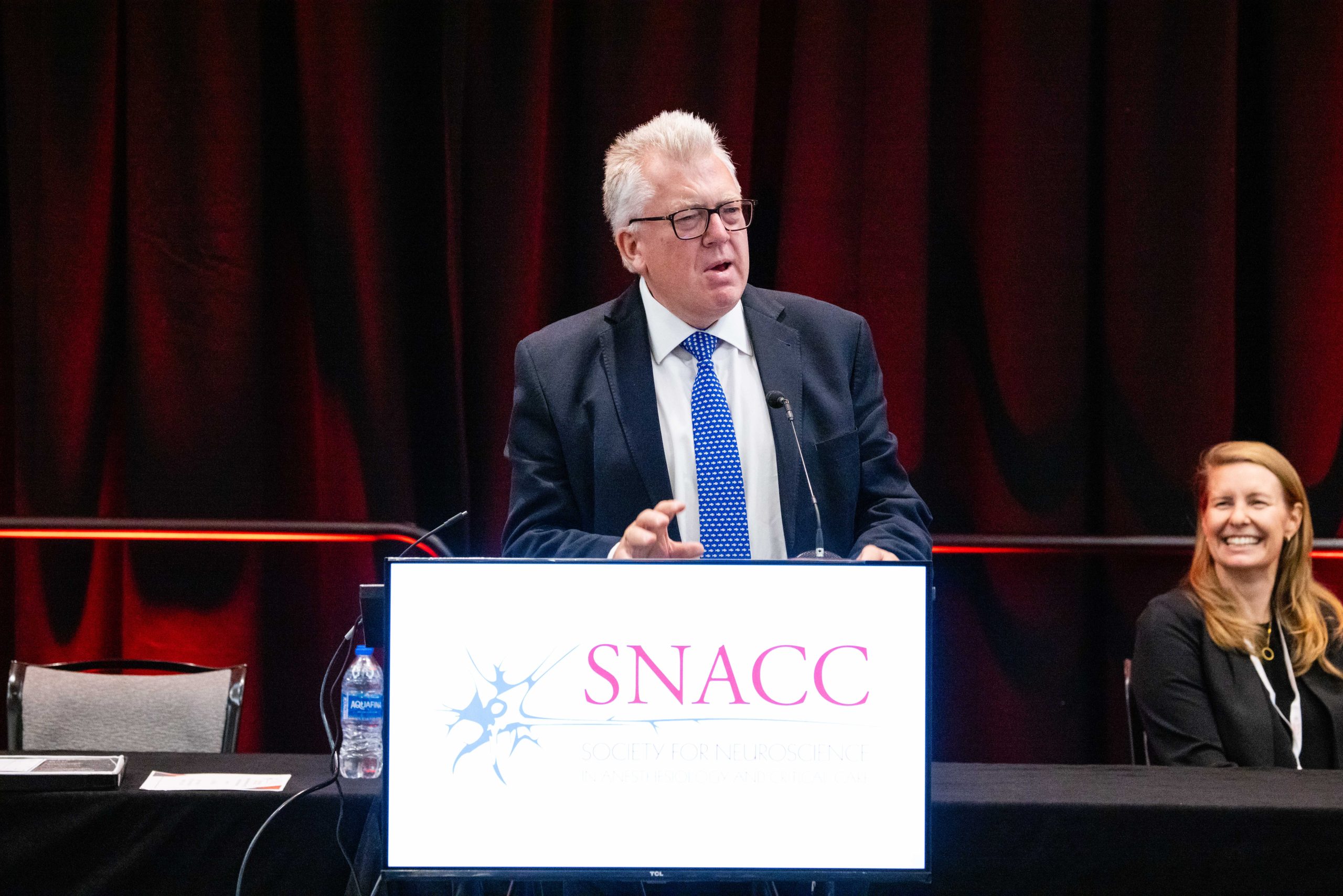
We are grateful for Professor Smith having agreed to this interview and for his ongoing contributions to the field.
I was hoping that you could share some of the most memorable moments of your career so far. Was there a specific experience that inspired you to pursue a career in neuroanesthesiology and neurocritical care?
During training, my primary interest was critical care. I didn’t have much exposure to neuroanesthesia until the last year of training and, to my surprise, I enjoyed it! Neurocritical care was in its infancy in the UK in the late 1980s, so my training was very much focussed on work in the operating room and neuroradiology suite. The hospital in which I was training had advanced plans to open a dedicated neurosurgical critical care unit and I saw an opportunity to combine my long-standing interest in critical care with my new-found interest in neuroanesthesia. Being appointed as director this neurocritical care unit was very much the result of being in the right place at the right time! Working with others to establish and develop a brand-new facility was a pivotal time in my career. Subsequently, my research interests developed from my day-to-day clinical work, and I was lucky enough to begin a research program with Professor Clare Elwell, a medical physicist at UCL, with whom I have collaborated for the last 35 years.
After completing your training, you were appointed as the inaugural director of the neurosurgical critical care unit at the National Hospital for Neurology and Neurosurgery in London, UK. What were some of the most important lessons that you learned from this experience?
The single most important lesson from the early days of the neurocritical care unit, and since, was the key importance of the multidisciplinary team in delivering outstanding clinical care and improving outcomes for patients. Key to this is the pivotal role of the bedside neuro ICU nurses who are the day-to-day drivers of excellent clinical care.
Who have been the most influential mentors in your career? How have these mentors helped shape your career?
This is a difficult question as there have been so many. During my neuroanesthesia training and early consultant years, I was greatly influenced by two UK neuroanaesthetists – Dr Doreen Jewkes and Dr Stuart Ingram. Both were both remarkable clinicians who managed hugely complex neurosurgical cases without much of the paraphernalia that we now regard as essential for even the most minor cases. In 1992, I attended my first SNACC meeting and met some of the ‘greats’ of neuroanaesthesiology which opened new doors for support and advice. I remember being amazed and grateful that these people who I recognized from reading their papers and textbooks were willing to engage with a very junior colleague from the UK. Several of them became mentors and, subsequently, close friends. Their support and advice have been a great encouragement throughout my career, and I am grateful to them.
What would you consider the most significant advancement in neuroanesthesiology and perioperative neurosciences during your career?
This is another difficult question because there have been so many. However, I would rank TIVA as a major advancement in neuroanesthesia to optimize delivery of anesthesia for neurosurgical patients. In the neuro ICU, the advent of bedside multimodal physiological brain monitoring has allowed targeted, individualized treatment for brain-injured patients.
What excites you about the future of perioperative neurosciences and neurocritical care?
I believe that there will be a step-change in non-invasive bedside brain monitoring in the next decade, and that the ability to monitor regional changes in cerebral physiology in real-time, and responses to treatment, will transform outcomes for patients. The other area that excites me relates to processes rather than technological or pharmacological developments. The concept of neuroanesthesiologists as perioperative physicians who contribute at all points in the perioperative neuroscience pathway has already brought improvements in acute stroke care, with neuroanesthesiologists now involved in all stroke codes in some centers. I am optimistic that this model will be translated more broadly and bring huge benefits for patients. The traditional notion of neuroanesthesiologists’ scope of practice being limited to the operating room is, thankfully, behind us.
Would you be able to tell us a bit about the evolution of the JNA during your time as Editor-in-Chief?
JNA was first published in 1989 as a dedicated source of information for the expanding subspeciality of neuroanesthesiology. While the original remit included much of what we today recognize as perioperative neuroscience, the content of JNA in the early days was inevitably focused on clinical neuroanesthesiology given the major developments that were occurring in this field. The remit of neuroanesthesiologists has evolved in the 35 years since the first issue of JNA was published along with major changes in clinical neuroscience. Similarly, the scope of JNA has been extended beyond a focus on anesthesia for neurosurgery to incorporate the entirety of perioperative neuroscience and brain health. The aim of these changes was not only to provide a broader perspective for established readers but also to extend the target readership of the journal to the whole perioperative neuroscience community.
What has been the most rewarding aspect of being Editor-in-Chief of the JNA? Is there any aspect of the role that surprised you?
Being entrusted by colleagues to give a fair hearing of their work submitted to JNA is a huge responsibility but also a huge privilege. I have learned so much from reading all manuscripts submitted to JNA during the last 7 years, whether they were ultimately accepted or not accepted for publication. There has been a welcome increase in submissions from authors in previously under-represented geographical areas, possibly related to early outreach work I undertook, and this has been a rewarding aspect of my role. Possibly the most surprising aspect is the willingness of colleagues, whether connected to the journal or SNACC, or not connected, to review articles submitted to JNA. The expertise of our reviewers is fundamental to the scientific quality of the journal and underpin its governance. The insightful and timely reviewers’ commentaries are as well-received by our authors as they are the Editor-in-Chief.
I am very grateful to have had the opportunity to serve as Editor-in-Chief of JNA, but it is now time for a change. I congratulate Dr Alana Flexman on her appointment as the next Editorial-in-Chief and look forward to the next phase of the JNA journey under Dr Flexman’s leadership.
You have held many leadership positions in your career, including the position of SNACC President, President of the UK Society of Neuroanaesthesia and Critical Care, President of the Critical Care Medicine Section of the Royal Society of Medicine, and Editor-in-Chief of JNA. What advice can you offer to the next generation of leaders in neuroanesthesia?
Make sure you have the support of others when considering taking on a leadership role and, importantly, that you have time to give to the role. These positions always more time consuming than you imagine, and often more time consuming that the previous incumbent will have suggested!
Are you able to describe your perfect day off? Where would you be, what would you be doing?
Spending time with my partner, family and friends enjoying good food and wine, and/or visiting new places.