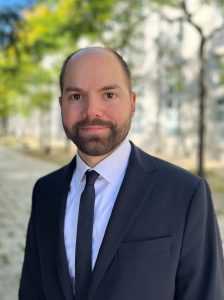




Dr. David Obert is an Assistant Professor in the Department of Anesthesiology and Intensive Care Medicine at the Technical University of Munich School of Medicine and Health in Germany. In 2023, while pursuing a research fellowship at Massachusetts General Hospital and Harvard Medical School, Dr. Obert was awarded the William L. Young Neuroscience Research Award for his work exploring the subcortical neural circuits involved in anesthetic emergence. We recently had the opportunity of interviewing Dr. Obert about his research and his journey from the operating room to the lab bench.
Can you tell us about your training and what initially drew you to neuroscience research?
I completed my medical degree at the University of Heidelberg, where the transition from high school directly to medical school didn’t allow for focused undergraduate training in a specific area. While working on my doctoral thesis, I developed an interest in basic research exploring endoplasmic reticulum stress and ischemia-reperfusion injury in the liver. This experience sparked my initial interest in resuscitation, emergency medicine, and intensive care – fields closely tied to anesthesiology.
Knowing I wanted to pursue an academic career in anesthesiology, I applied for the residency program at the Department of Anesthesiology and Intensive Care Medicine at Klinikum rechts der Isar in Munich, which has a strong focus on neuroscience. From the beginning of my residency, I was captivated by how anesthetic drugs modulate consciousness. This interest deepened as I observed during my clinical work how some patients experience disturbances in consciousness after anesthesia, such as delirium, particularly in the post anesthesia care unit.
Driven by the correlation between intraoperative anesthetic management and postoperative outcomes, I began studying intraoperative EEG monitoring. This work, combined with my growing fascination with the brain’s complexity, led me to participate in a clinician-scientist program that provided protected time to dive deeper into neuroscience research. My focus expanded to investigate top-down vs. bottom-up mechanisms in the brain and motivated me to seek postdoctoral training to broaden my methodological toolbox. Eager to gain international experience, I was granted a postdoctoral fellowship at Massachusetts General Hospital to continue this journey.
What have been the most rewarding aspects of working as a physician-scientist?
As a physician, I encounter delirious ICU patients on a daily basis, witnessing the profound effects of anesthesia and surgery on the brain. As a scientist, my research focuses on exploring the mechanisms behind these phenomena, evaluate electrophysiological correlates of disturbed consciousness, and develop innovative approaches. Ultimately, the goal is to improve the translatability of animal research to clinical practice, thereby optimizing patient recovery and outcomes.
Working with animal models gives me a different perspective on problems, sharpening my ability to think outside the box and approach clinical challenges with creative solutions. This dual role empowers me to ask clinically relevant research questions and devise strategies that may ultimately benefit patients. Additionally, mentoring and collaborating with interdisciplinary teams while advancing clinical practice and scientific knowledge makes this career path deeply fulfilling.
What do you see as the greatest obstacles facing trainees and early-career anesthesiologists aiming to pursue research, and what advice would you offer them?
One of the greatest difficulties is finding a balance between clinical responsibilities and research commitments. The rigorous demands of clinical training, especially during residency, can make it difficult to allocate sufficient time to research. Trainees may feel the pressure to master specialized procedures during clinical rotations and on-call duties, leaving limited room for academia. Another significant challenge is securing funding and mentorship—both essential for establishing a research career. Access to protected research time is often limited, which can hinder progress for those starting out.
To overcome these challenges, I would advise trainees to follow their interests and focus on areas they are genuinely passionate about. Pursuing a field that excites you naturally fosters greater dedication, making it easier to persevere through obstacles and achieve excellence. It’s also crucial to seek mentorship from experienced physician-scientists who can offer guidance on managing both clinical and research demands effectively. Engaging in clinician-scientist programs, which provide structured support and protected research time, can be an invaluable resource.
I also recommend building a strong network by attending research meetings and conferences, such as those hosted by SNACC. These gatherings offer opportunities to connect with peers, gain exposure to cutting-edge research, and foster collaborations with senior researchers. Thinking creatively and embracing interdisciplinary approaches are equally important. For example, working with animal models not only deepens scientific understanding but also provides fresh perspectives on clinical challenges, encouraging innovative thinking.
By following their passion, seeking mentorship, and leveraging supportive networks, trainees can navigate the complexities of a dual career in clinical anesthesiology and research, ultimately contributing meaningfully to the field.
Can you tell us more about your research and how receiving the William Young Award has contributed to your success?
As previously mentioned, my journey as a researcher has been shaped by a diverse array of interests, beginning with basic science in resuscitation, transitioning into clinical neurophysiology, and ultimately merging these fields into mechanistic neuroscience research. While I currently pursue basic neuroscience projects focused on arousal circuits and anesthesia, I remain actively engaged in clinical investigations, such as exploring how patient characteristics influence intraoperative brain function monitoring.
The project supported by the William Young Award focuses on identifying and characterizing arousal circuits that reverse anesthetic-induced unconsciousness. By the age of 70, statistically nearly everyone will experience general anesthesia at least once. While these drugs are essential for modern medicine, they carry significant risks, including potentially life-threatening side effects. Furthermore, most anesthetics lack reversal agents, which could significantly enhance safety and efficiency in clinical settings.
Previous work in the lab demonstrated that electrical stimulation of the ventral tegmental area (VTA) – a midbrain region – can reverse unconsciousness induced by sevoflurane, fentanyl, and dexmedetomidine. However, the VTA contains two key groups of excitatory neurons: dopaminergic and glutamatergic. Electrical stimulation does not allow differentiation between these populations, leaving questions about their individual roles unanswered.
Using optogenetics, we aimed to dissect these neuronal populations to understand their specific contributions. The William Young Award provided critical support for this project and allowed me to present my work to a broader audience, for which I am very grateful. Our findings so far suggest a substance-specific potential for these neurons to reverse anesthetic-induced unconsciousness. We are in the final stages of analyzing the data and are excited to share our results soon.
Looking ahead, what emerging areas of research are you most excited about?
The potential of personalized approaches in anesthesia is one of the topics I am most excited about. Moving beyond a “one-size-fits-all” model, future anesthetic care will integrate individual patient characteristics, including not only chronological age but also biological age and general health. By assessing personal risk factors for conditions like postoperative delirium (POD) and cognitive decline, we can develop tailored anesthetic strategies to optimize safety and recovery.
Advances in neuroscience and technology will be central to this transformation. Evaluating a patient’s susceptibility to anesthetic side effects or their ability to benefit from emerging reversal agents could guide more precise drug selection and dosing. Tools like intraoperative brain monitoring and biomarker assessments will enable real-time adjustments based on each patient’s unique physiology, improving both safety and outcomes.
This shift toward patient-centered, individualized care has the potential to redefine anesthetic practice. It excites me to envision a future where anesthesia is tailored to each patient to minimize risks and provide optimal recovery.