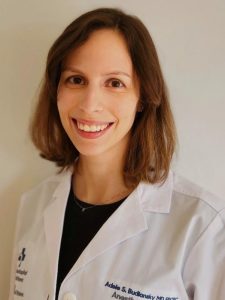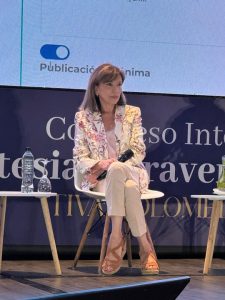




For this issue of the SNACC Newsletter, it is my pleasure to interview Dr. Maria Claudia Niño.
Dr. Maria Claudia Niño is a neuroanesthesiologist and intensivist, currently serving as a University Professor and Head of the Neuroanesthesia Fellowship and the Neuroanesthesia Section at Fundación Santa Fe de Bogotá, Colombia. Dr. Niño’s academic and clinical work is focused on advancing neuroanesthesia and critical care, with a strong commitment to teaching and research.
- Can you please describe the neurosurgical and neuroanesthesia practices at your institution, Hospital Universitario Fundación Santa Fe de Bogotá?
At the Hospital Universitario Fundación Santafé de Bogotá, we maintain a robust and evolving neurosurgical and neuroanesthesia practice. As an institution affiliated with the Universidad de los Andes, we are deeply committed to both patient care and the education of future specialists. Our Department of Anesthesiology and Perioperative Medicine boasts a diverse team of anesthesiologists with expertise in various subspecialties, including neuroanesthesia, pain management, cardiovascular anesthesia, pediatric anesthesia, regional anesthesia, obstetric anesthesia, and epidemiology—all of whom hold diplomas in education.
Our neuroanesthesia section supports multiple operating rooms dedicated to neurosurgery and spine surgery, where we perform approximately 5-8 procedures daily. We work closely with a dedicated neuro-intensive care unit staffed by neuro-intensivists. The hospital itself is a 500-bed facility that sees a wide variety of complex neurological cases.
Our neuroanesthesia practice is deeply integrated with the neurosurgical team, participating in pre-operative planning, intraoperative management, and post-operative care. We emphasize a multidisciplinary approach to optimize patient outcomes. Significantly, our neuroanesthesia fellowship program has achieved a landmark accreditation, being the first in Latin America to be recognized by both the ICPNT (International Council on Perioperative Neurosciences Training) and SNACC. This underscores our commitment to the highest standards of training and patient care in neuroanesthesia.
- What inspired you to pursue a career in neuroanesthesiology?
My journey into medicine began at the Pontificia Universidad Javeriana de Bogotá, Colombia. During my internship, I met Dr. Alberto Campos, an anesthesiologist with profound knowledge of physiology and pharmacology, who ignited my interest in anesthesiology.
Even before that, I had a profound influence. I married Dr. Juan Armando Mejia, a neurosurgeon, and through him, I learned a lot about neurology, neurosurgery, and neuroanatomy from my pre-graduate days. Later, my interest in the brain and the influence of our management on patient outcomes continued to grow. My decision to specialize in neuroanesthesiology was fueled by a desire to protect and optimize the brain during surgical procedures. Before the end of my specialization, we decided to travel to the Karolinska Hospital in Stockholm where I had the fortune of meeting Professor Olof Norlander. I decided to train in neuroanesthesiology, and during that time, my interest in the brain and the influence of our management on patient outcomes continued to grow.
- Who have been the most influential mentors in your career? How have mentors helped shape your practice as a neuroanesthesiologist and a Program Director?
I have been fortunate to have several influential mentors throughout my career. One of the most important was Professor Olof Norlander , the head of the anesthesiology department at Karolinska Hospital in Stockholm, an investigator, passionate about teaching and very committed to the concepts of mechanical ventilation in intensive care and operating room patients. Professor Norlander, was very committed to the concepts of mechanical ventilation in intensive care and operating room patients. I also had the opportunity to work with Dr. Emeric Gordon, head of the Neuroanesthesia Section, and Dr. Michael Lagerkranser, whose research, publications, and commitment to the care of neurological patients inspired me daily. In Colombia, Dr. Eduardo Garcia, who had been trained at the Mayo Clinic and pioneered intensive care in our country, greatly supported and inspired me.
My mentors instilled in me the importance of evidence-based practice, continuous learning, and a commitment to patient safety. They taught me to always question assumptions, seek out new knowledge, and advocate for my patients’ best interests. I participated in investigations related to the ventilatory work of patients under general anesthesia. I then returned to Colombia with the dream of training professional anesthesiologists interested in and committed to the care of our patients’ brains. I completed training in Intensive Care. As a Program Director, I strive to emulate their dedication to education and mentorship, fostering a supportive environment where fellows can develop their skills and pursue their passions. My mentors helped shape my practice as a neuroanesthesiologist and as a Program Director by instilling in me the importance of evidence-based practice, continuous learning, and a commitment to patient safety.
- What neuroanesthesia principle or teaching point are you most passionate about?
I am most passionate about the principle that “time is brain.” In neuroanesthesia, every second counts, and our interventions can have a profound impact on patient outcomes. I emphasize the importance of rapid assessment, precise management of hemodynamics and oxygenation, and proactive strategies to prevent secondary brain injury. I am also passionate about teaching the importance of continuous monitoring and vigilance, as well as the need to anticipate and manage potential complications. My motto is that time is the brain and that the craniotomy reflects the management that we, as anesthesiologists, give to patients.
- How would you describe your teaching philosophy? Has this changed over time?
My teaching philosophy is centered on creating a learning environment that is both challenging and supportive. I encourage my students to think critically, ask questions, and actively participate in their education. I believe in the importance of hands-on experience and provide ample opportunities for fellows to develop their skills in the operating room and intensive care unit. I am mindful of the importance of quality as part of our daily practice.
Over time, my teaching philosophy has evolved to incorporate new technologies and pedagogical approaches. I am always seeking new ways to engage students and make learning more effective. In addition, and according to my experience, neuroanesthesiologists must be up-to-date, always up-to-date, committed to teaching, committed to the perioperative care of patients. We must participate in the decision boards, where behaviors are discussed and we must carefully monitor the post-operative evolution. Research, a little difficult in our countries, due to economic limitations, must also be part of our lives.
- What advice do you give your fellows as they are graduating and beginning their careers as staff neuroanesthesiologists?
As my fellows graduate and embark on their careers as staff neuroanesthesiologists, I offer them the following advice:
• Never stop learning: The field of neuroanesthesia is constantly evolving, so it is essential to stay up-to-date with the latest research and clinical guidelines.
• Be a patient advocate: Always put your patients’ needs first and advocate for their best interests.
• Collaborate with colleagues: Neuroanesthesia is a team sport, so work closely with surgeons, neurologists, and other healthcare professionals to provide the best possible care.
• Embrace challenges: Neuroanesthesia can be demanding, but it is also incredibly rewarding. Embrace the challenges and strive to make a positive impact on your patients’ lives.
I have had the honor of training colleagues from Panama, Ecuador, Mexico, Venezuela, Dominican Republic and Colombia. It is very gratifying to find that all of them have positioned themselves as neuroanesthesiologists and as teachers reproducing knowledge in their countries, and that every time we have a scientific meeting in Latin America I share discussion panels and round tables with many of them.