



As the official journal of SNACC, the Journal of Neurosurgical Anesthesiology has a long history of publishing original and review articles relevant to the SNACC membership. Dr Alana Flexman is the Editor-in-Chief. Subscribe to the JNA e-Table of Contents here and follow JNA on:
- Twitter/X: @JNA_Journal
- Instagram: @jna_journal
- Blusky: @jnajournal.bsky.social
Online access to the JNA is a benefit of SNACC membership.
We are excited to share highlights of the July 2025 issue of the Journal of Neurosurgical Anesthesiology (JNA) as well as the Fellows’ Journal Club authored by Dr Elouise Donaldson. The Fellows’ Journal Club articles align with both the SNACC Advanced Neuroanesthesia Classroom and the ICPNT Neuroanesthesia Fellowship curriculum.
Each issue of the JNA is accompanied by a podcast and a free-to-attend joint ICPNT-JNA webinar with recordings of the joint webinars available on the SNACC Learning Management System:
-
- Upcoming JNA Podcast: Dr Bryan Benson interviews Dr Jason Chui on: The Impact of Neuroanesthesia Fellowship Training and Anesthesiologist-Surgeon Dyad Volume on Patient Outcomes in Adult Spine Surgery: A Population-Based Study Chui J., Ng, W., Yang, V., Duggal, N. Journal of Neurosurgical Anesthesiology 37(2):206-215 DOI: 10.1097/ANA.0000000000000978
- Latest joint JNA – ICPNT Journal Club with authors Dr Cara Rathmell and Dr Suzana Vacas discussing “Transfusion Thresholds in Patients With Neurological Injury: Balancing Oxygen Delivery and Risk.” Journal of Neurosurgical Anesthesiology 37(3):265-270 DOI: 1097/ANA.0000000000001039
Highlights from JNA July 2025 issue
Jo, W. Y., Shin, K. W., Lee, H. C., Park, H. P., Kim, J. H., Lee, C. H., Kim, C. H., Chung, C. K., & Oh, H. (2025). Effect of Erector Spinae Plane Block on Postoperative Quality of Recovery in Patients Undergoing Transforaminal or Oblique Lumbar Interbody Fusion: A Randomized Controlled Trial. Journal of neurosurgical anesthesiology, 37(3), 296–304. https://doi.org/10.1097/ANA.0000000000001003
In this randomized control trial, the authors investigated the impact of erector spinae plane blocks (ESPB) on quality of recovery in patients undergoing transforaminal lumbar interbody fusion. Quality of recovery (QoR) was measured using the QoR-15 score. Secondary outcomes included post-operative pain at ambulation and rest, and time to ambulation. ESPB did not improve QoR when measured using QoR-15 but there was a lower mean pain score during, and reduced time to, first ambulation.
Kurita, S., Furutani, K., Mitsuma, Y., Deguchi, H., Kamoda, T., Kamiya, Y., & Baba, H. (2025). Effect of Remimazolam on Transcranial Electrical Motor-evoked Potential in Spine Surgery: A Prospective, Preliminary, Dose-escalation Study. Journal of neurosurgical anesthesiology, 37(3), 325–329. https://doi.org/10.1097/ANA.0000000000000983
This study investigates the impact of increasing doses of remimazolam on motor evoked potentials (MEPs) in 10 adult patients undergoing posterior spine fusion. The remimazolam dose increased from 1mg/kg/hr to 2mg/kg/hr, with a bolus of 0.1mg/kg. The MEPs were measured from the left grastrocnemius muscle. The authors found no difference in MEP amplitude with increased remimazolam dose. An infographic designed by Dr Arnoley Abcejo accompanies this article (figure 1).
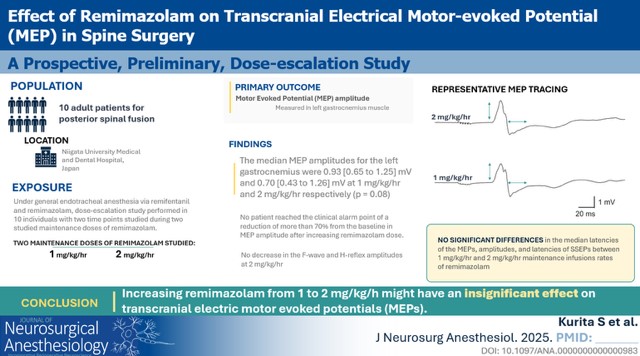
Figure 1. Effect of Remimazolam on Transcranial Electrical Motor-evoked Potential in Spine Surgery. Infographic created by Dr Arnoley Abcejo.
Lele, A. V., Moreton, E. O., Mejia-Mantilla, J., & Blacker, S. N. (2025). The Implementation of Enhanced Recovery After Spine Surgery in High and Low/Middle-income Countries: A Systematic Review and Meta-Analysis. Journal of neurosurgical anesthesiology, 37(3), 242–254. https://doi.org/10.1097/ANA.0000000000001006
This review article and meta-analysis investigates the implementation of enhanced recovery after surgery (ERAS) programs following spine surgery globally, with a resultant reduction in hospital length of stay and cost demonstrating benefit of ERAS in diverse settings. The authors also found an increase in the number of publications from low-middle income countries since 2017 with a focus on randomized controlled trials in adult patients undergoing complex spine surgery.
Rathmell, C., & Vacas, S. (2025). Transfusion Thresholds in Patients with Neurological Injury: Balancing Oxygen Delivery and Risk. Journal of neurosurgical anesthesiology, 37(3), 265–270. https://doi.org/10.1097/ANA.0000000000001039
This focused review examines current evidence for transfusion thresholds (restrictive and liberal) in patients critically ill with neurological pathology, highlighting the importance of ensuring a balance between prevention of secondary brain injury and transfusion related risks. The authors conclude that individualised transfusion thresholds are ideal in adult patients with brain injury, and for patients with a higher risk of cerebral ischemia, a liberal transfusion policy may be indicated. Transfusion of blood products must be accompanied by a clear indication. Further research should investigate optimal transfusion strategies and thresholds in neurological pathology to ensure best patient outcome.
The authors present the development and validation of a 2-step outcome prediction model for functional independence at 90-days in patients undergoing endovascular thrombectomy (EVT). 1676 patients were enrolled into the study with an 80:20 split for development and validation of the model that was developed using data from the Chinese registry (ANGEL-ACT). The authors found that the model, (which included age, NIHSS and ASPECT score, admission glucose and systolic blood pressure, time from stroke onset to puncture and successful reperfusion) could be useful for predicting functional independence at 90-days after treatment.
The next issue of the JNA will be published online in September 2025.